Chicago Artists Coalition and Buddy at Chicago Cultural Center
Rund Gallery and apexart Gallery
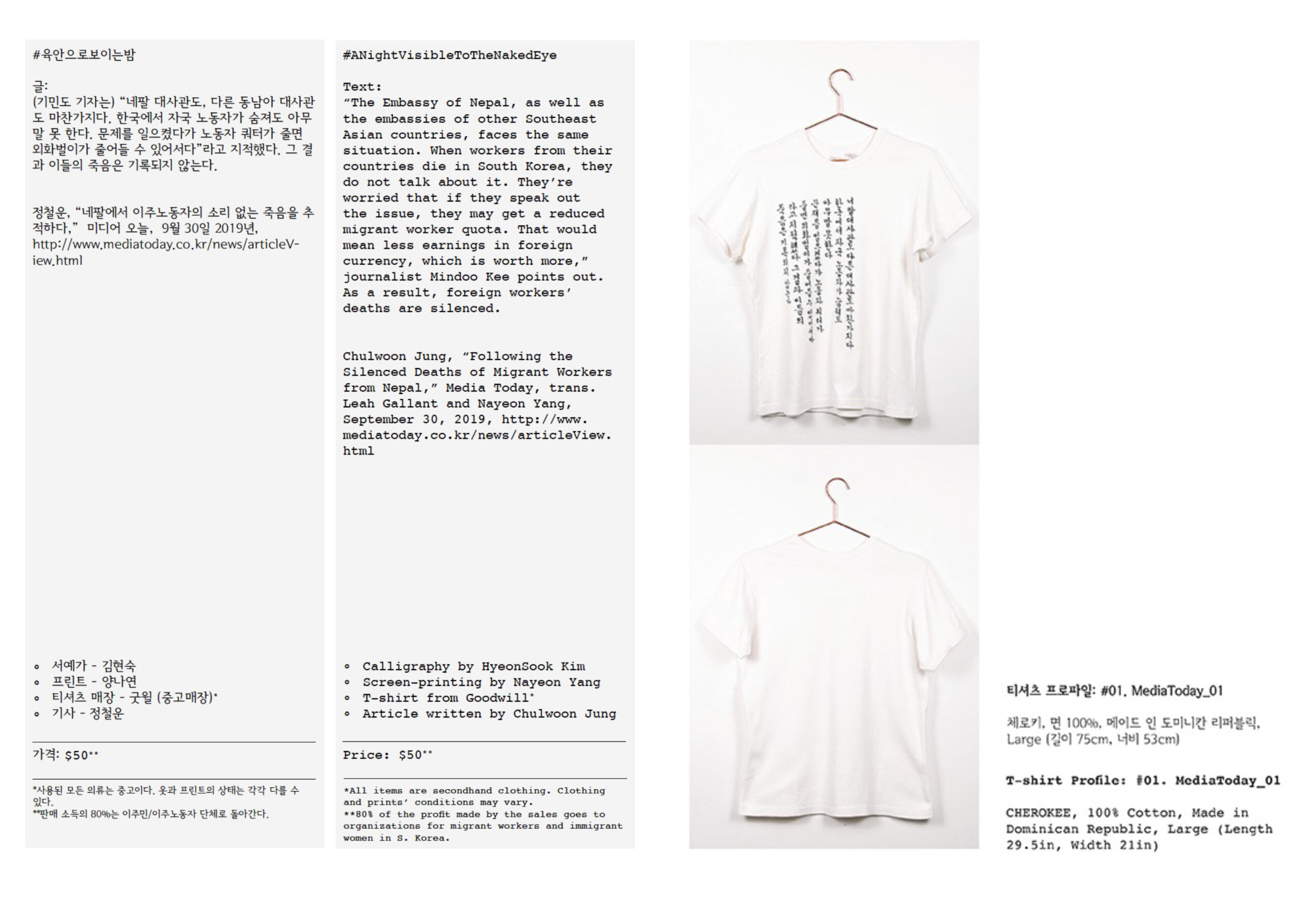
“The Embassy of Nepal, as well as the embassies of other Southeast Asian countries, faces the same situation. When workers from their countries die in South Korea, they do not talk about it. They’re worried that if they speak out the issue, they may get a reduced migrant worker quota. That would mean less earnings in foreign currency, which is worth more,” journalist Mindoo Kee points out. As a result, foreign workers’ deaths are silenced.
–––
Chulwoon Jung, “Following the Silenced Deaths of Migrant Workers from Nepal,” Media Today, trans. Leah Gallant and Nayeon Yang, September 30, 2019, http://www.mediatoday.co.kr/news/articleView.html
(기민도 기자는) “네팔 대사관도, 다른 동남아 대사관도 마찬가지다. 한국에서 자국 노동자가 숨져도 아무 말 못 한다. 문제를 일으켰다가 노동자 쿼터가 줄면 외화벌이가 줄어들 수 있어서다”라고 지적했다. 그 결과 이들의 죽음은 기록되지 않는다
–––
정철운, “네팔에서 이주노동자의 소리 없는 죽음을 추적하다,” 미디어 오늘, 9월 30일 2019년,
http://www.mediatoday.co.kr/news/articleView.html
A large number of migrant workers live on farms in Pocheon, Gyeonggi. Two or three people stay in a dorm room smaller than 285 square feet. A restroom is outside of the house.
Even if the migrant workers want to change jobs because of the poor working and living conditions, they face institutional barriers to doing so[1]. Last year, no requests for change of job due to living conditions were accepted. The Employment Permit System gives employers absolute sovereignty. The reality today is worse than Jeon Tae-il’s era.
–––
Eunii Lee and Minji Cha, “CBS ‘Greenhouse, Shipping Container House…’ Another Name of Jeon Taeil,” NoCut News, trans. Leah Gallant and Nayeon Yang, November 12, 2020, https://www.nocutnews.co.kr/news/5445719.
이주노동자 대거 둥지 튼 경기 포천 농장
팔평도 안 되는 공간에 두세명 기거 …화장실은 집밖
열악한 근무지 바꾸고 싶어도 제도 장벽 너무 높아
지난해 기숙사 문제로 사업장 변경 건수 영 건
고용허가제 고용주에 절대주권…전태일보다 못한 현실
–––
이은지·차민지, CBS “비닐하우스, 조립식 패널…”또 다른 이름의 ‘전태일’,” 노컷뉴스, 11월 12일 2020년 https://www.nocutnews.co.kr/news/5445719
[1] Under the Employment Permit System (EPS), migrant workers cannot choose or change their workplaces without their employers’ permission. Migrant workers are assigned to random workplaces as Korean employers “pick” them. It is also the employers’ power to extend their Visa. Some activists address EPS as a modern slavery system. (translator’s note)
The issue about dangerous work being outsourced becomes exacerbated as migrant workers are now targeted for the dangerous work. In Korean society, instead of monitoring safety performance and regulating dangerous conditions to work in, companies hire migrant workers because they can be dispensable at any time. After all, large numbers of migrant workers are sent to hazardous workplaces without even receiving safety education.
–––
Wan Lee, “Dangerous Work for Outsourced Workers, Dangerous Work for Migrant Workers,” KyeongIn Daily News, trans. Leah Gallant and Nayeon Yang, August 7, 2019, http://www.kyeongin.com/main/view.php?key=20190806010001649.
위험의 외주화를 넘어 이주민화가 일어나고 있다. 한국사회는 현장의 위험을 관리할 수 있는 시스템을 바꾸는 대신, 그곳에 언제든 대체할 수 있는 이주노동자를 보내고 있다. 결국, 현재 이주노동자들이 기본적인 안전교육조차 제대로 받지 못하고 대거 투입되고 있다.
–––
이완, “위험의 외주화, 위험의 이주민화,” 경인일보, 8월 7일 2019년 http://www.kyeongin.com/main/view.php?key=20190806010001649
More than 30% of women migrant workers experience workplace violence or sexual harassment. However, the victims are not able to report the incidents because they are afraid of getting fired. They consider reporting the harassment pointless because they are “foreign women.”
–––
KyeongNam Kang, “More Than 30% of Women Migrant Workers in Gwangju are Victims of Workplace Sexual Harassment,” GwangjuDream, trans. Leah Gallant and Nayeon Yang, January 29, 2020, http://www.gjdream.com/news/articleView.html?idxno=502409
이주여성노동자들의 삼십퍼센트 이상이 폭력이나 성희롱 성폭력 피해 경험을 당하고, 피해를 입고도 해고가 두렵거나 ‘외국인여성’이라 항의해도 소용없을까 봐 대처조차 못하고 있다는 것.
–––
강경남, “광주 이주여성노동자 30% 이상 성희롱·성폭력 피해,” 광주드림, 1월 29일 2020년,
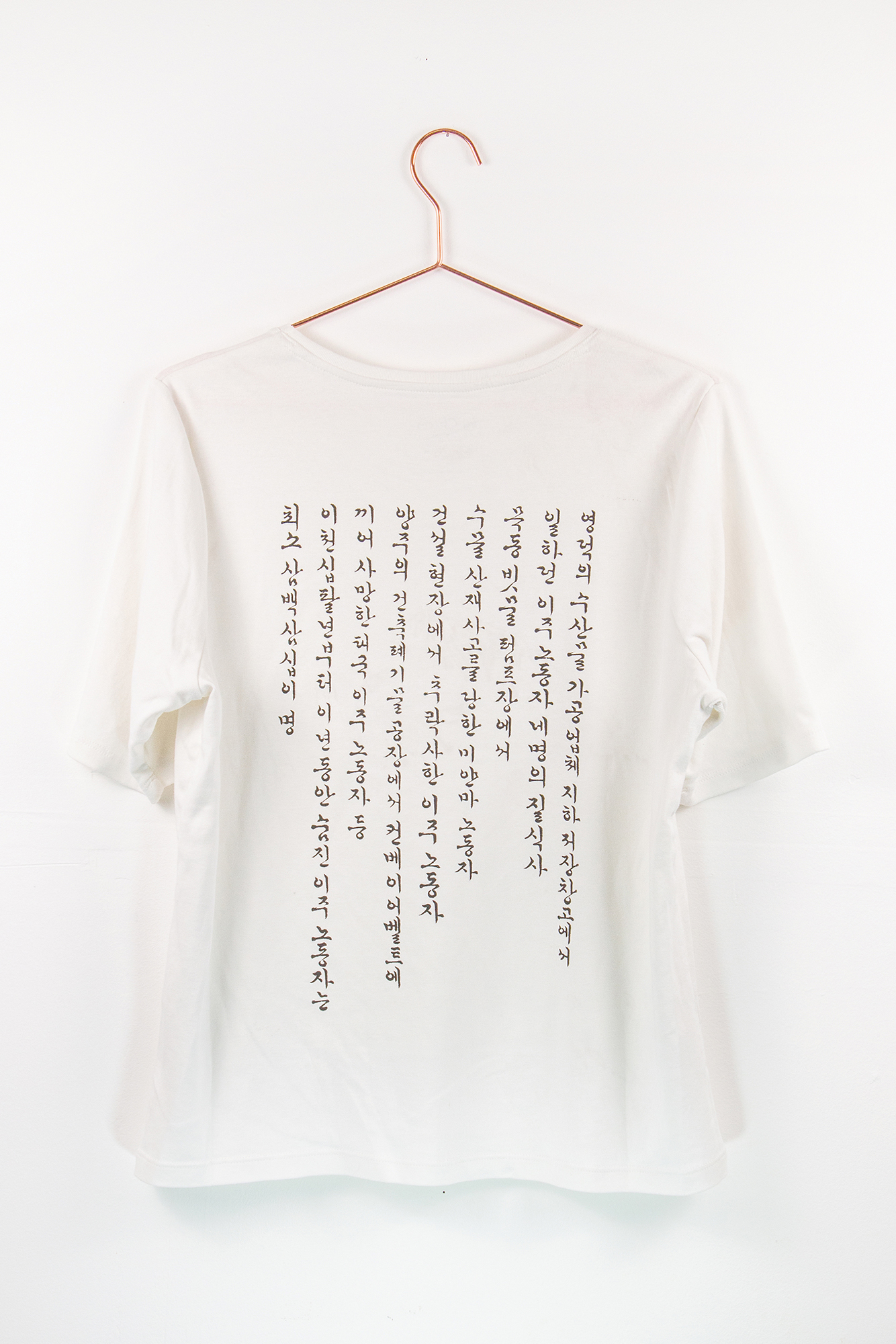
Four migrant workers who suffocated in the warehouse storage of a seafood processing company in Yeongdeok. A worker from Myanmar who drowned at a stormwater pumping station in Mok-dong. A Thai migrant who was sucked into a conveyor belt at a construction waste plant in Yangju. Another migrant worker who died from a fall at a construction site. Since 2018, in just two years, at least 332 migrant workers have died.
–––
Jongho Lee, “In the Past Two Years, At Least 332 Migrant Workers Die in Industrial Accidents,” Ulsan Journal, trans. Leah Gallant and Nayeon Yang, April 15, 2020, http://www.usjournal.kr/news/newsview.php?ncode=1065590305540745.
영덕의 수산물 가공업체 지하 저장창고에서 일하던 이주노동자 4명의 질식사, 목동 빗물펌프장에서 수몰 산재사고를 당한 미얀마 노동자, 건설 현장에서 추락사한 이주노동자, 양주의 건축폐기물 공장에서 컨베이어벨트에 끼어 사망한 태국 이주노동자 등 2018년부터 2년 동안 숨진 이주노동자는 최소 332명.
–––
이종호, “2년 동안 산업재해로 숨진 이주노동자 최소 332명,” 울산저널, 4월 15일 2020년,
http://www.usjournal.kr/news/newsview.php?ncode=1065590305540745
It was around this time last year, in the middle of this project, when I heard about the death of Cambodian migrant farmworker Nuon Sokkheng amid a cold wave of minus 4 degrees Fahrenheit. However, I needed more than simple sympathy: I had to remind myself of what I wanted to do by representing the tragedy of others.
We are living in a strange world. “How on earth can spinach be this expensive?” On one hand, we complain about the surge in consumer prices. On the other hand, we are upset about using migrant workers as cheap disposable labor. We hear that some places have a difficult time due to a lack of workers, while elsewhere, some workers are let go. While we applaud internationally successful Korean products and culture, we also display hate toward “foreigners” and “immigrants” who may come to S. Korea with the Korean Dream. Among these dichotomies, there are layers of frameworks, such as society, culture, country, capital, law, and history. And somewhere in between, ‘I/we’ exists actively or passively as a consumer, as a worker, as a citizen, and as a foreigner.
Who is “we,” and what is “Korean”? Ironically, the othered existence of “foreigners” is the necessary condition for the collective identity of “we” and “Citizen” to exist. Reversing this relationship, I try to call out the identity of Koreans as foreigners outside Korea, where the Korean “Citizen” means foreigners. In the US, foreign alphabets—including the Korean alphabet Hangul—arts, cultural objects, foods, and their meanings are quickly reduced to a foreign cipher. They are transformed into cultural “Others” and “interesting” things that Americans “discover.” Texts in Korean calligraphy, regardless of whether they are well-written or not, present something “oriental” and “cool”—like T-shirts with broken and unintelligible English text sold in Korea.
—
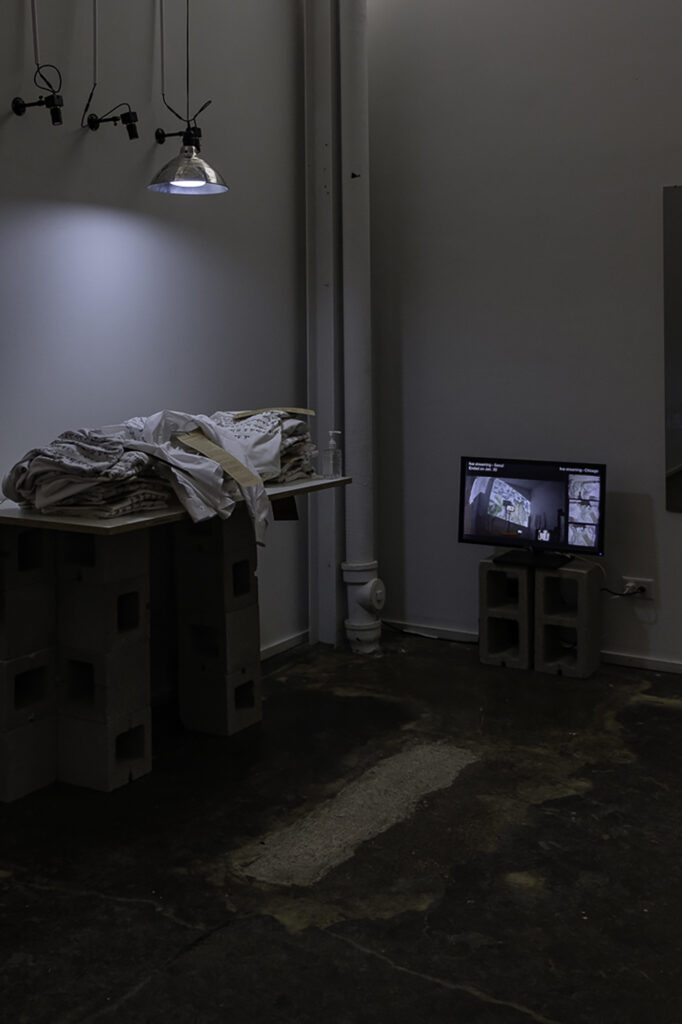
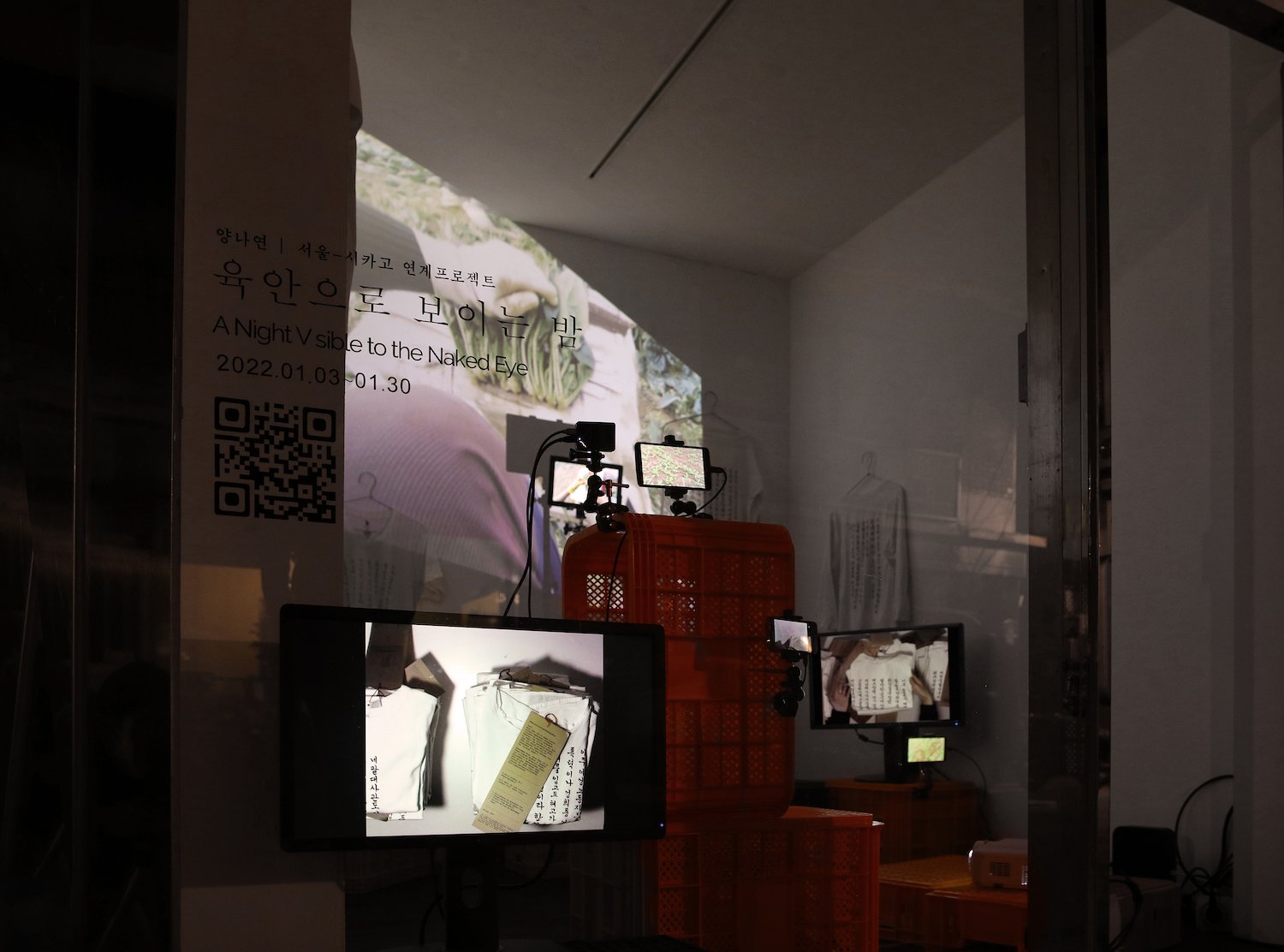
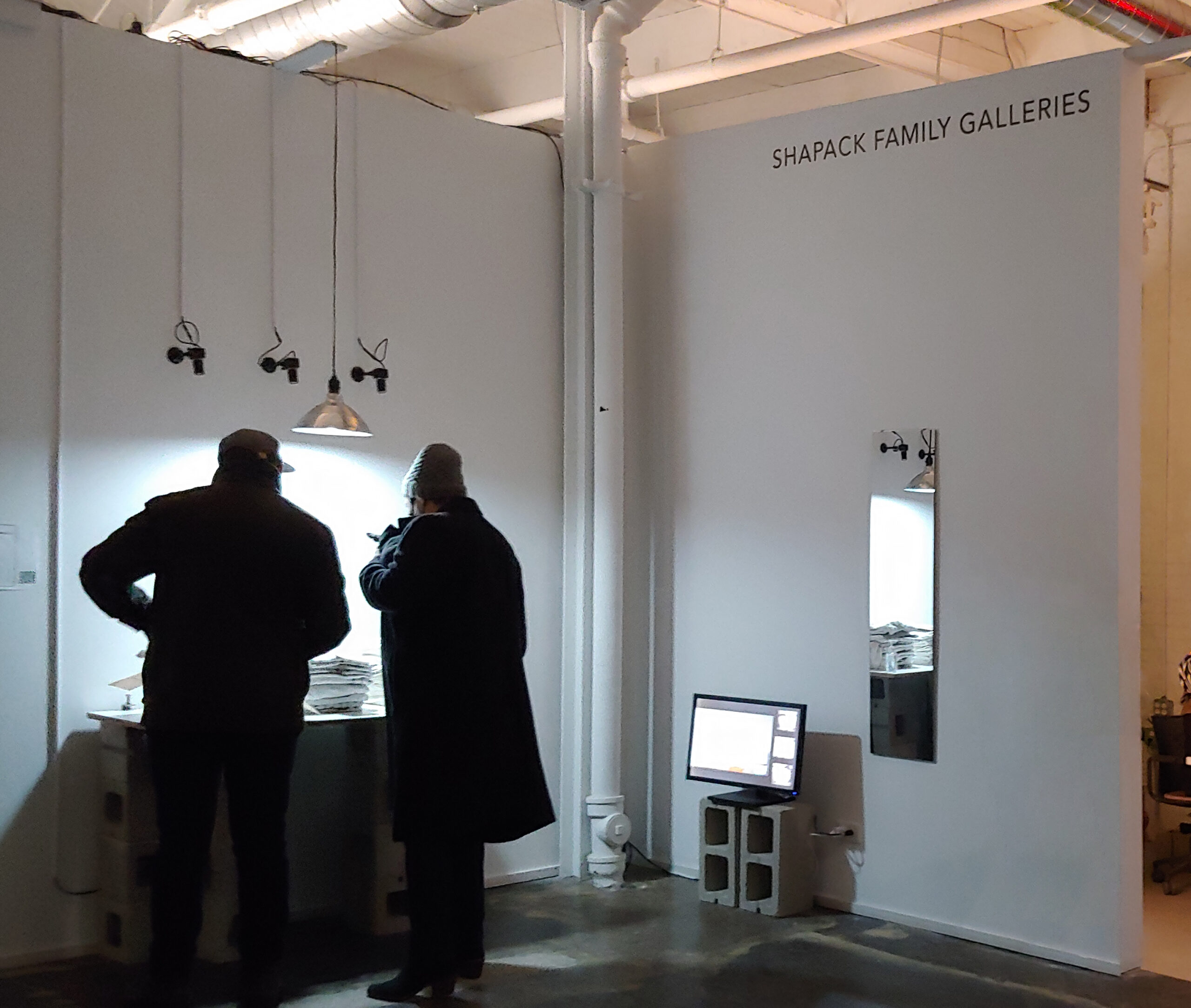
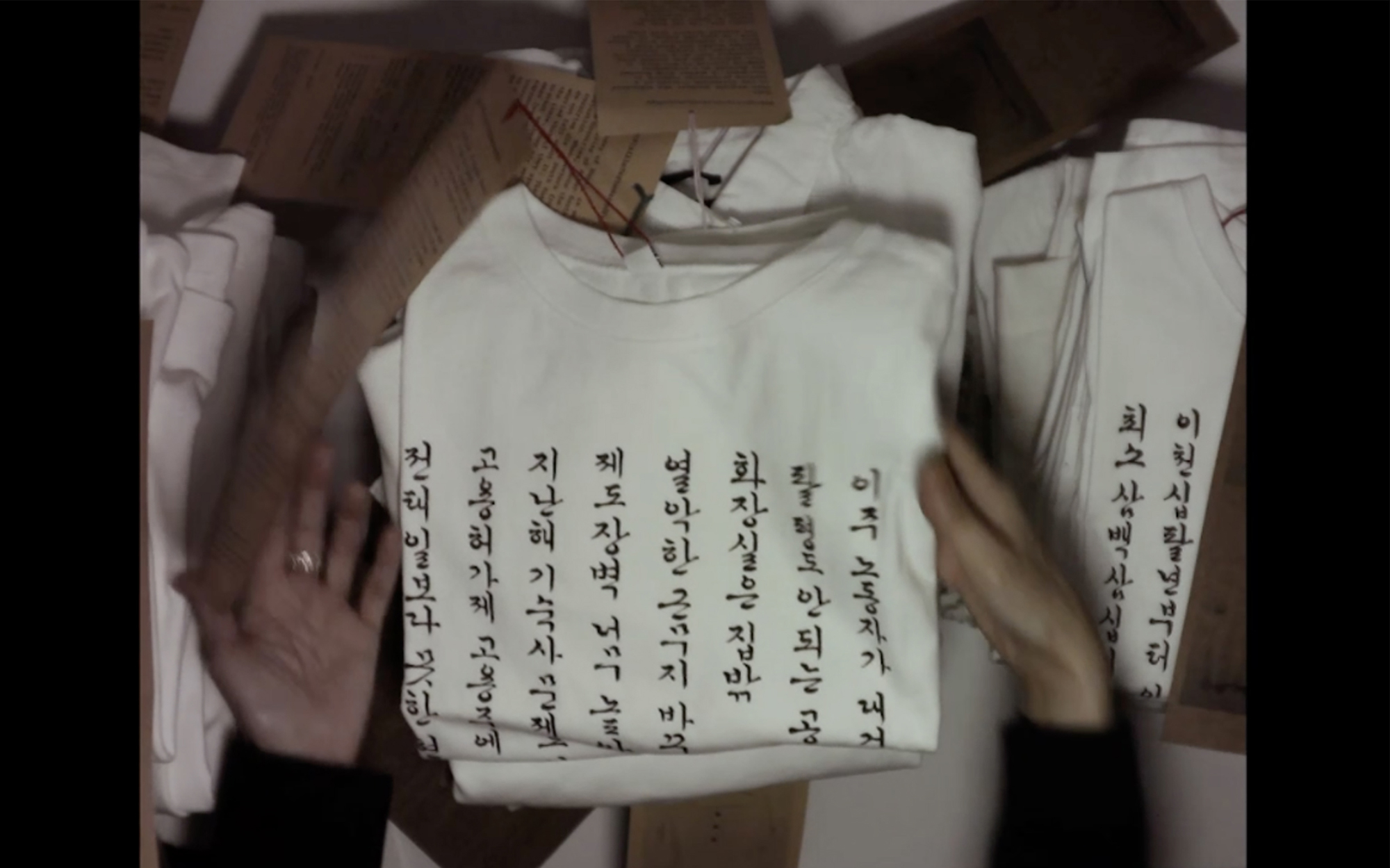
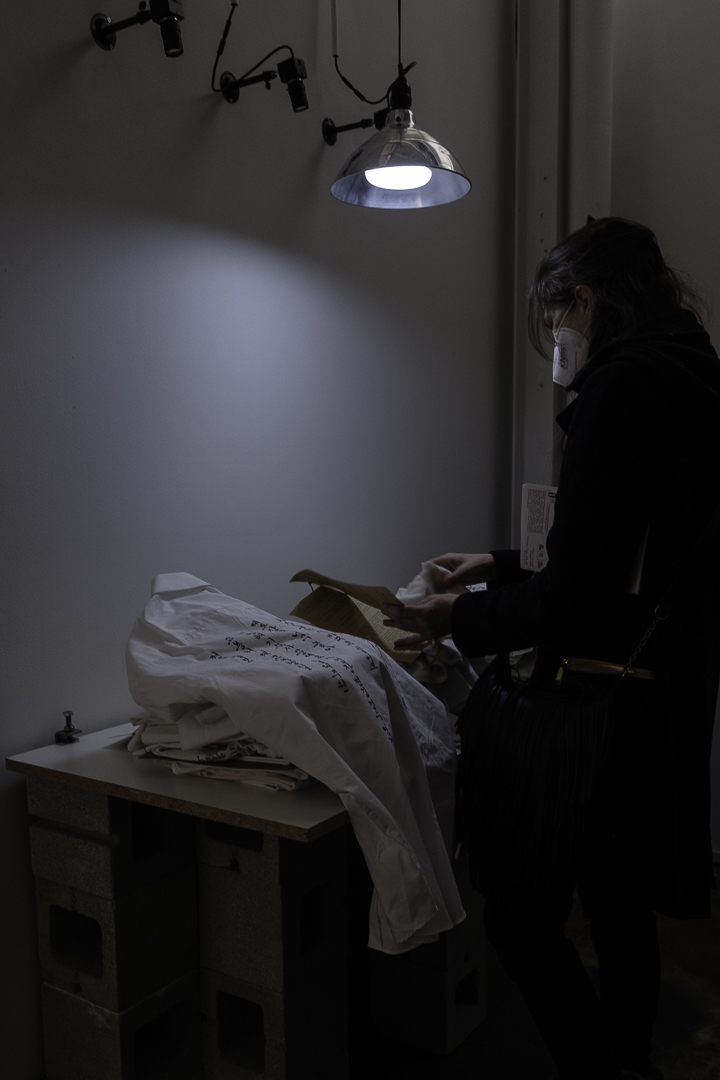
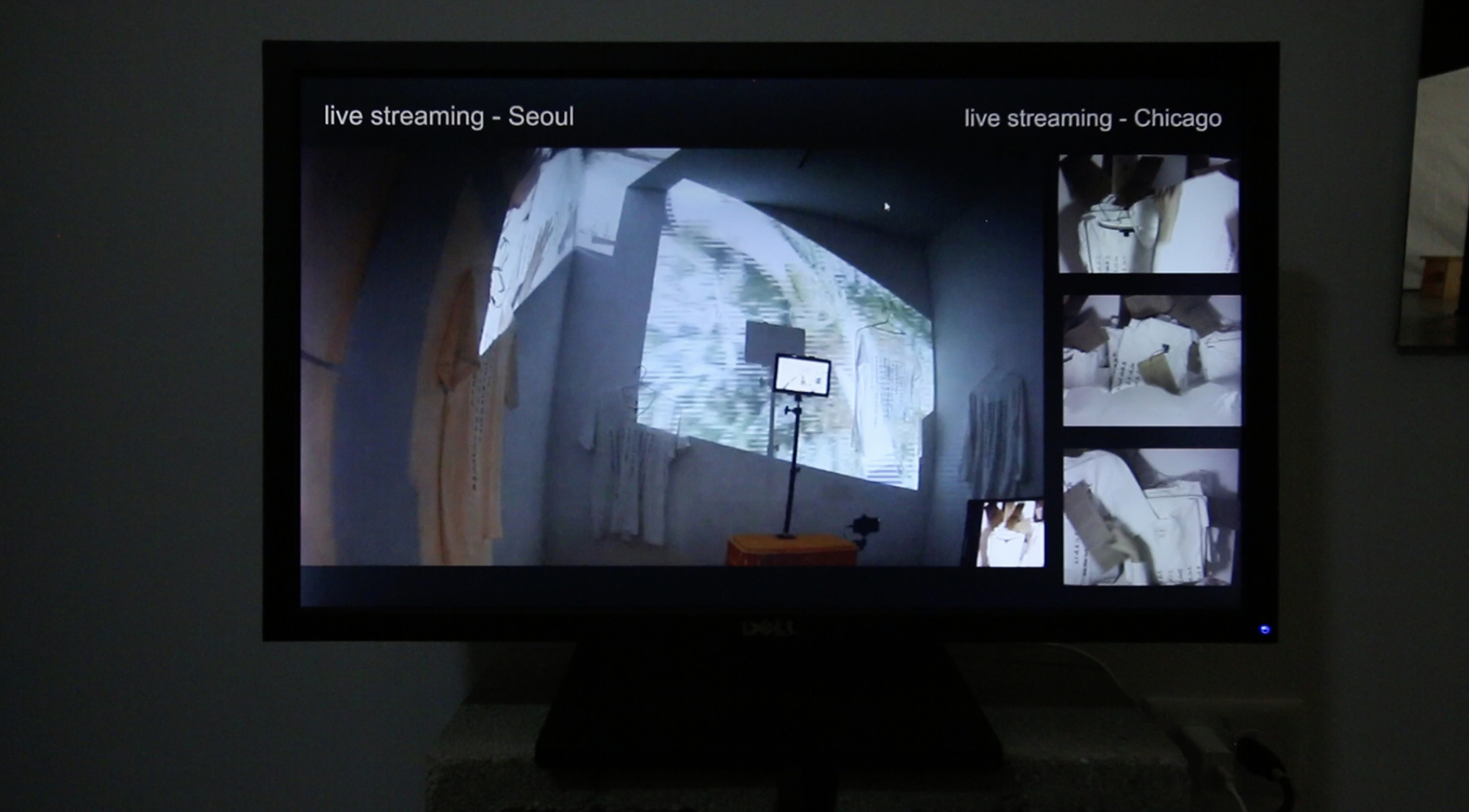
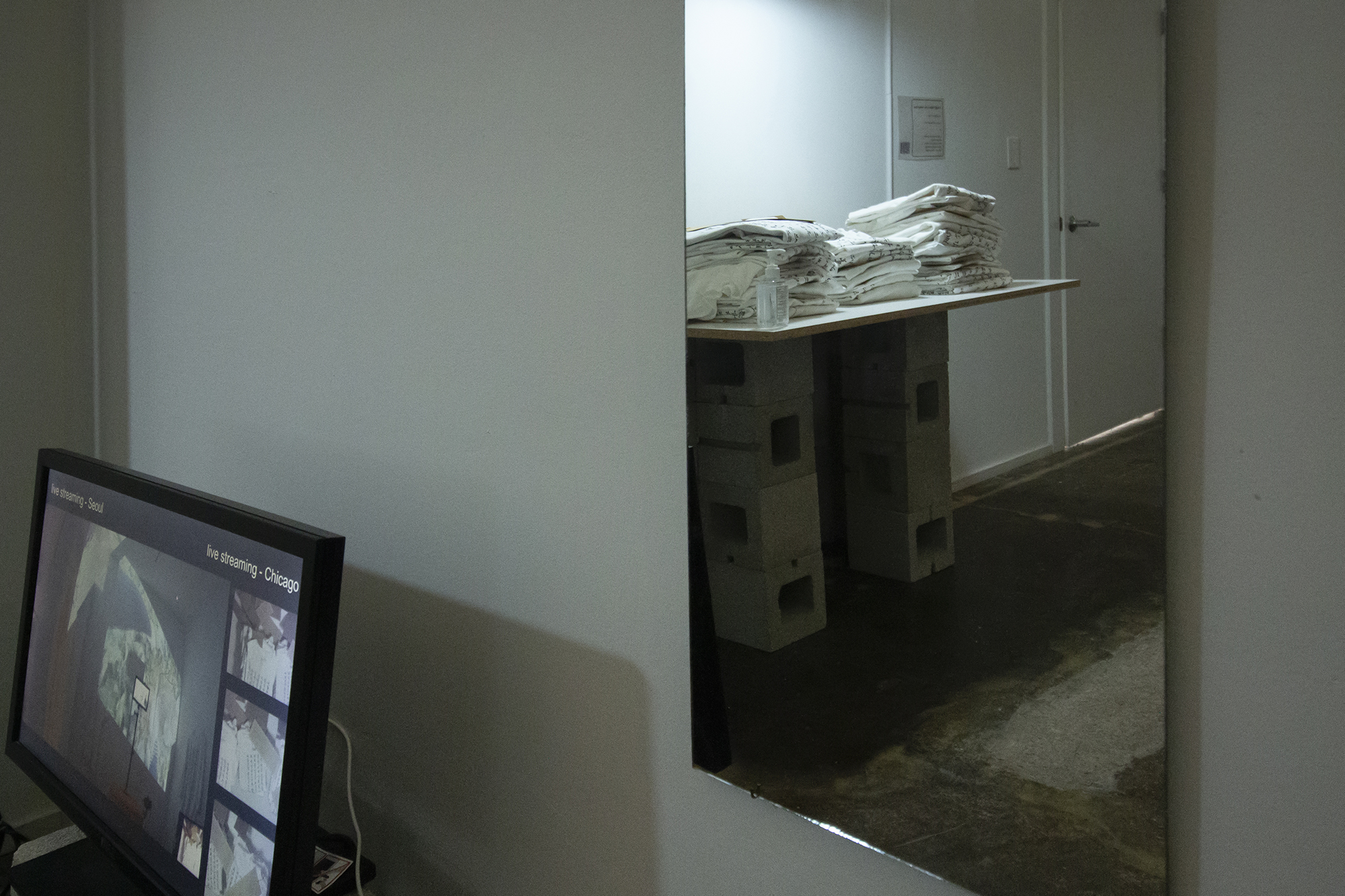
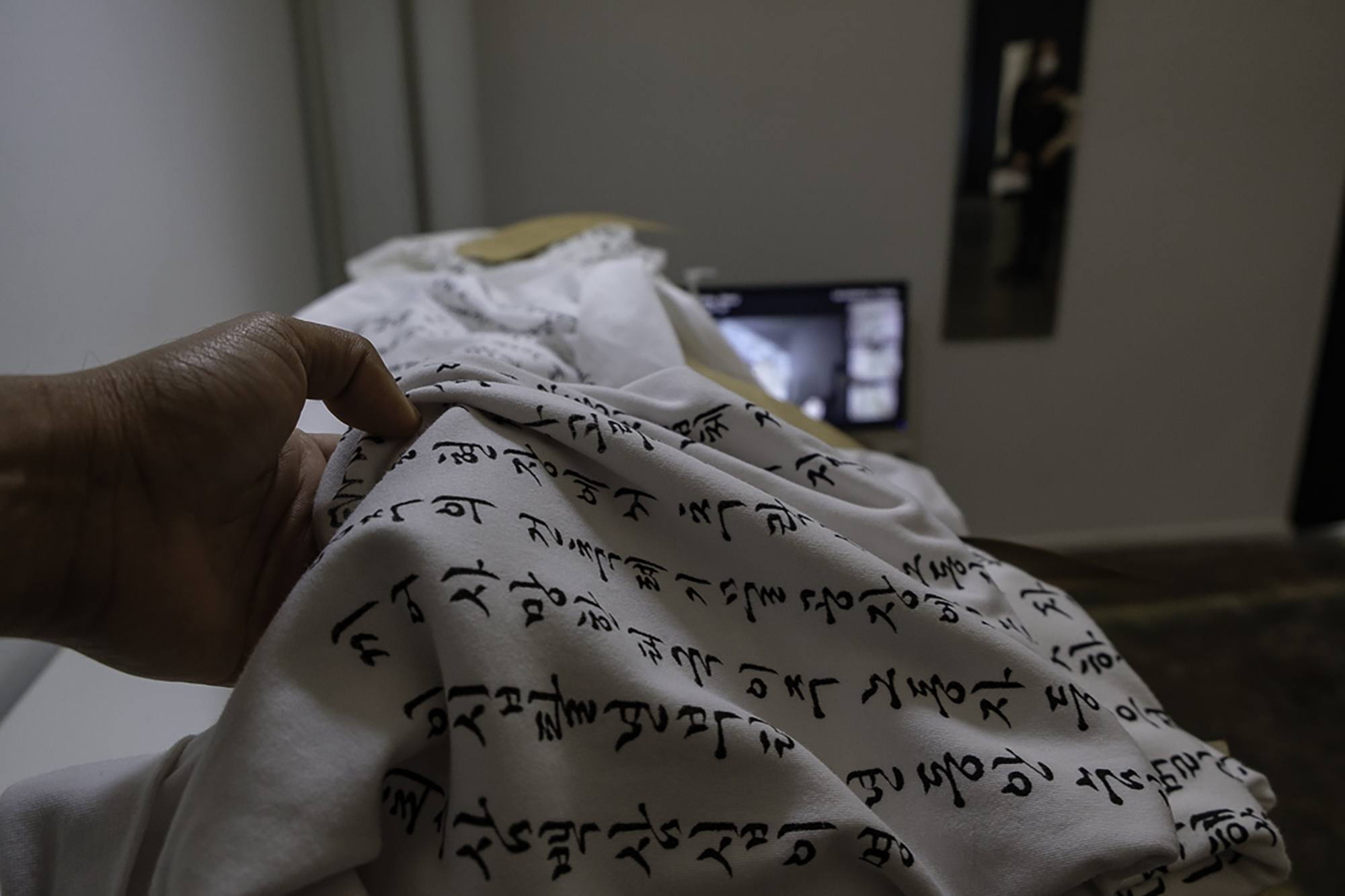
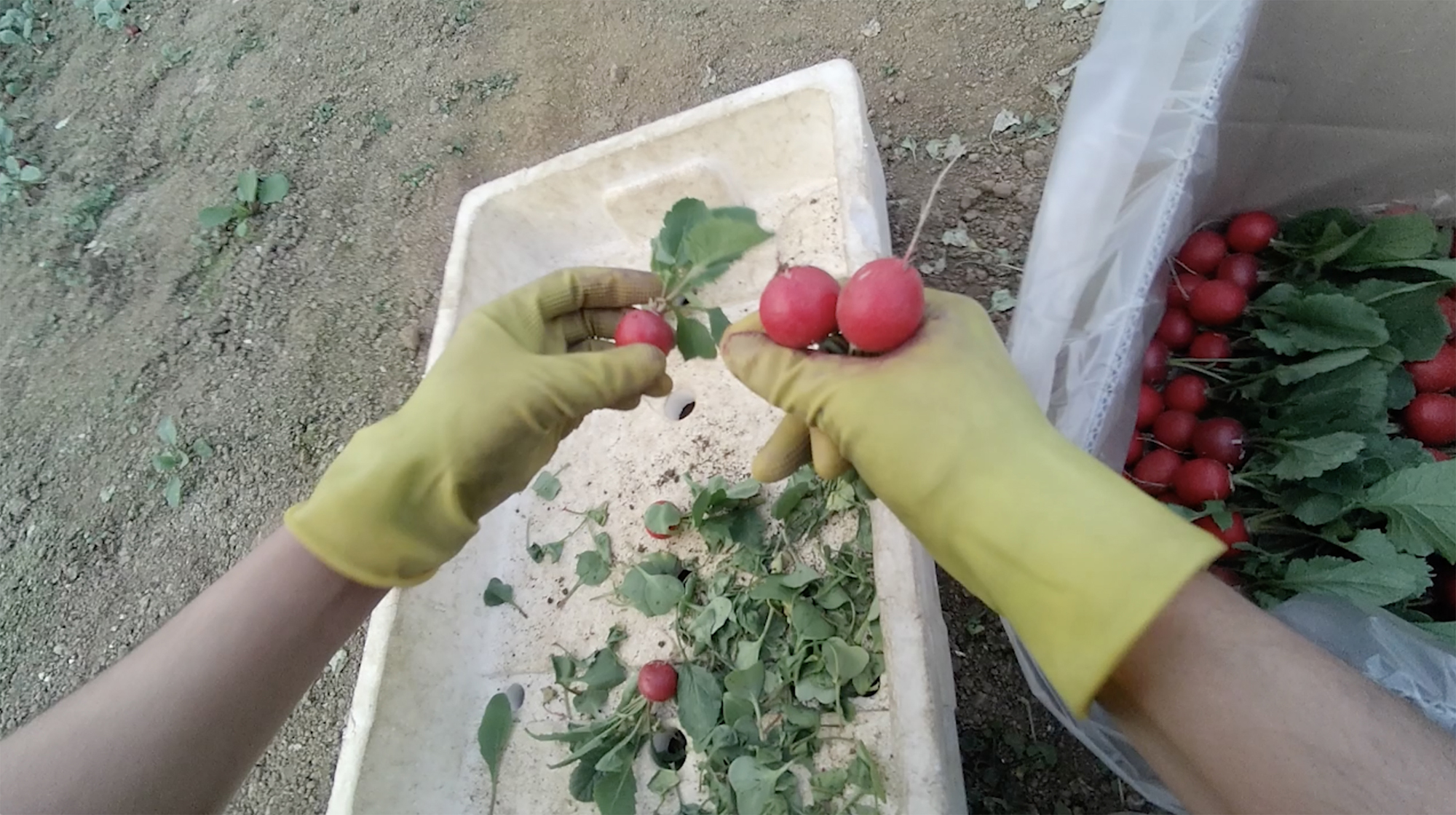
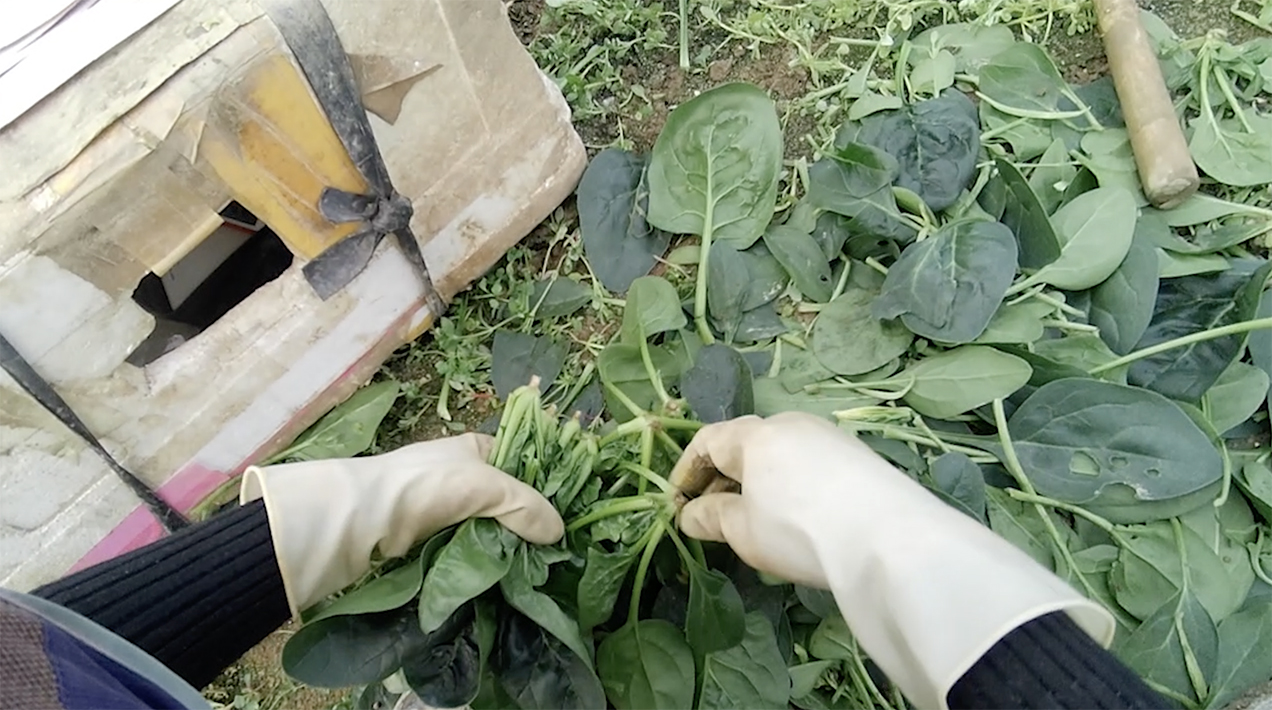
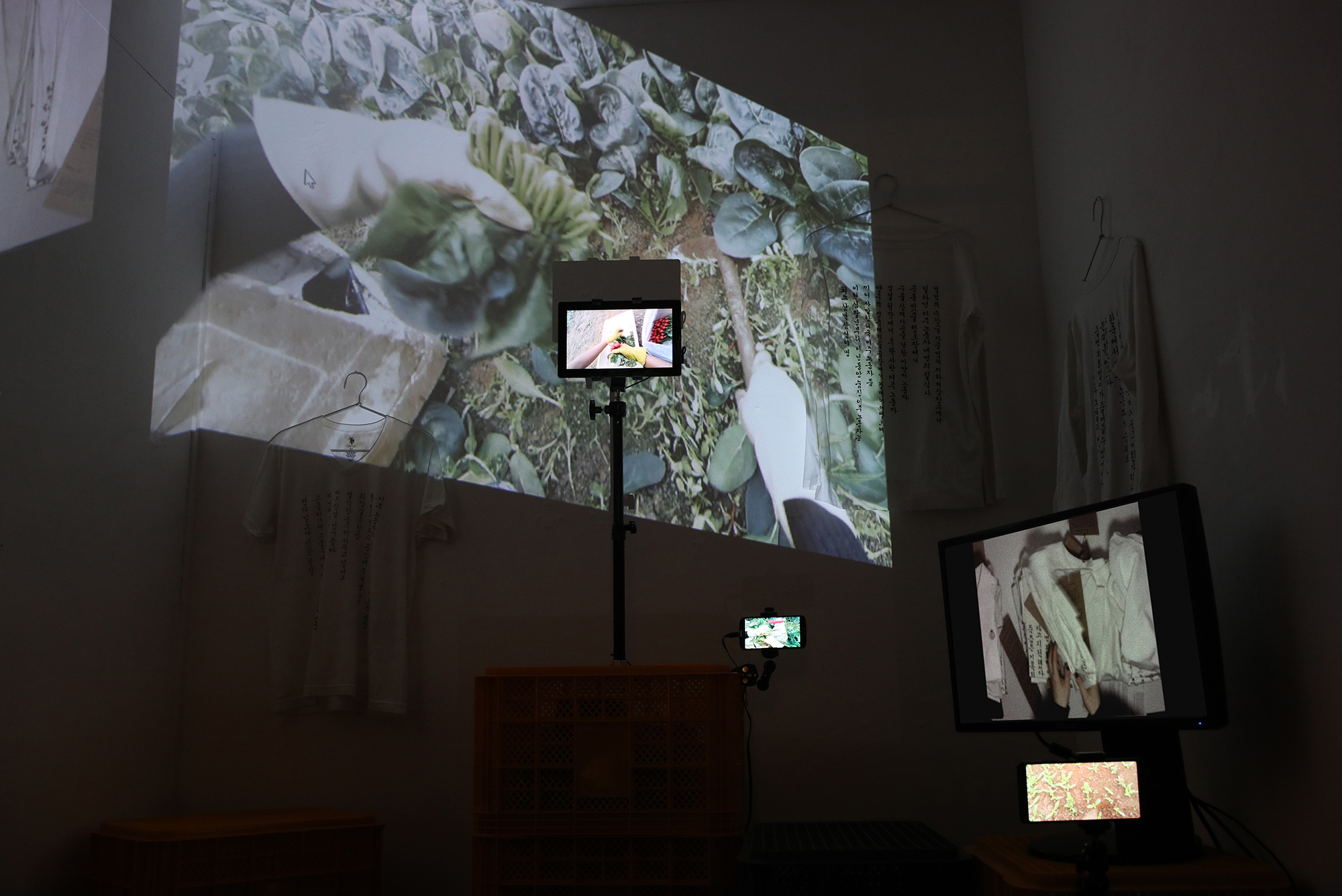
A Night Visible to the Naked Eye is concerned with the interconnected nature of the global economy, and people who experience it. The form of the project mimics entangled relationships among nations, labor, capital, arts, and cultures. It interweaves multi-channel live-feed video, screen-printing, Korean calligraphy, t-shirt sales, and five articles about the exploitation of migrant workers and immigrant women in South Korea printed on t-shirts. Initially, the project is designed to be presented simultaneously: Part 1 is the print t-shirt sale where overhead cameras capture shoppers’ hands searching clothing at a gallery/store in Chicago; and Part 2 is a live-feed video installation at a gallery in Seoul, Korea. In the video installation, the live videos of the clothing and shoppers’ interactions alongside videos of migrant workers’ working hands show, blending gestures of producing and consuming. Eventually, this video installation view is recaptured by another live-feed camera and broadcast to a monitor at the store in Chicago as well as a website accessible to the audience in the US. Due to the time difference between the two countries, live-feed videos from the other country would seem inactive during the daytime and become more animated at night.
Through this project, I hope to pursue the following questions: Can a Korean-reading audience relate to the texts’ contents on the t-shirts more than a non-Korean-reading audience? Would we be able to think these are “our” problems or the “poor” “foreign” workers’ issues? When the non-Korean reading audience/shoppers purchase the printed t-shirts, what would they really “buy” in this project? And what would the audience in Korea witness when seeing people in a Western country searching through and buying clothing with dire events written on them, which would eventually “help”* the migrant workers working in S. Korea?
*The 80% of profit made through the t-shirt sale goes to migrant workers supporter groups and organizations
영하 20도 한파 속 캄보디아 이주노동자 누온 속헹 씨의 사망 소식을 들은 게 작년 이맘때쯤, 12월 말이었다. 한창 이 프로젝트를 진행하는 때여서 더 절실한 기분이 들었다. 그리고, 나의 불행을 넘어 타인의 불행을 팔아 나는 무엇을 하고자 하는지 다시 한번 생각해 봐야 했다. 단순한 공감보다는 책임감이 절실했다.
우리는 이상한 세상에서 살고 있다. 물가는 치솟아 마트에 갈 때마다 지갑은 유난히 홀쭉해 보여 ‘시금치 한 단에 뭐가 이리 비싸?’ 하지만, 한편에서 우리는 이주노동자의 열악한 환경과 임금에 분노한다. 한쪽에서는 일손이 부족해 일이 안 돌아간다는 하소연을 듣는가 하면, 또 다른 한쪽에서는 부당 해고된 노동자의 이야기를 듣는다. 외국으로 진출한 한국 문화, 노동력, 사업엔 박수를 보내는가 하면, 한국에 대한 좋은 이미지와 기대를 갖고 도착한 이주노동자에겐 ‘외국인 차별, 혐오’를 유감없이 보여주기도 한다. 이 이야기들 사이엔 여러 사회, 문화, 국가, 자본, 법, 역사 등과 같은 틀과 연결고리가 존재하고, 그리고 그사이에 어딘가에 ‘나’라는 사람도 소비자로서, 국민으로서, 외국인으로서, 노동자로서, 생산자로서 능동적으로 혹은 수동적으로 존재한다.
—
‘우리’란 누구이고, ‘한국인’이란 무엇인가. 어떤 자격과 같이 존재하는 ‘국민’이란 테두리에 기대고 있는 집단적 정체성이 극적으로 드러나는 곳은 아이러니하게도 ‘외국인’이라는 타자화된 존재를 통해서다. 이 관계를 뒤집어 국민이라는 단어가 중화되고 혹은 축소될 수밖에 없는 국외(國外)공간에서 만들어지는 외국인으로 서의 한국인이라는 정체성을 불러내고자 한다. 우리의 글도, 미(美)도, 뜻도 외국에 나가면 쉽게 외국어이고, 이국적 미(美)로 국한되며, 타자이고 대상으로 전환된다. 한글 서예도 다수의 외국인에게는 어느 나라 글자인지도, 뜻도, 그리고 잘 쓴 글씨인지조차 모르지만, 뭔가 동양적이고 ‘쿨’한 색다른 무엇일 뿐이다. 한국에서도 많이 볼 수 있는 맥락이 없거나 말이 안 되는 영문 티셔츠와 같이.
—
나는 <육안으로 보이는 밤>을 통해 이민자의 노동과 이동, 그리고 신자유주의의 관계를 고찰하고자 한다. 이 프로젝트는 이주민/노동자의 기사 발췌 글을 매개로 실크스크린 프린트, 판매, 그리고 실시간 비디오 등의 여러 매체를 엮음과 동시에 미국과 한국이라는 문화와 지역적 상황을 틀로써 활용한 장소 특정적 작업이다. 따라서 프로젝트는 미국과 한국에서 동시 연계 발표를 목표로 한다.
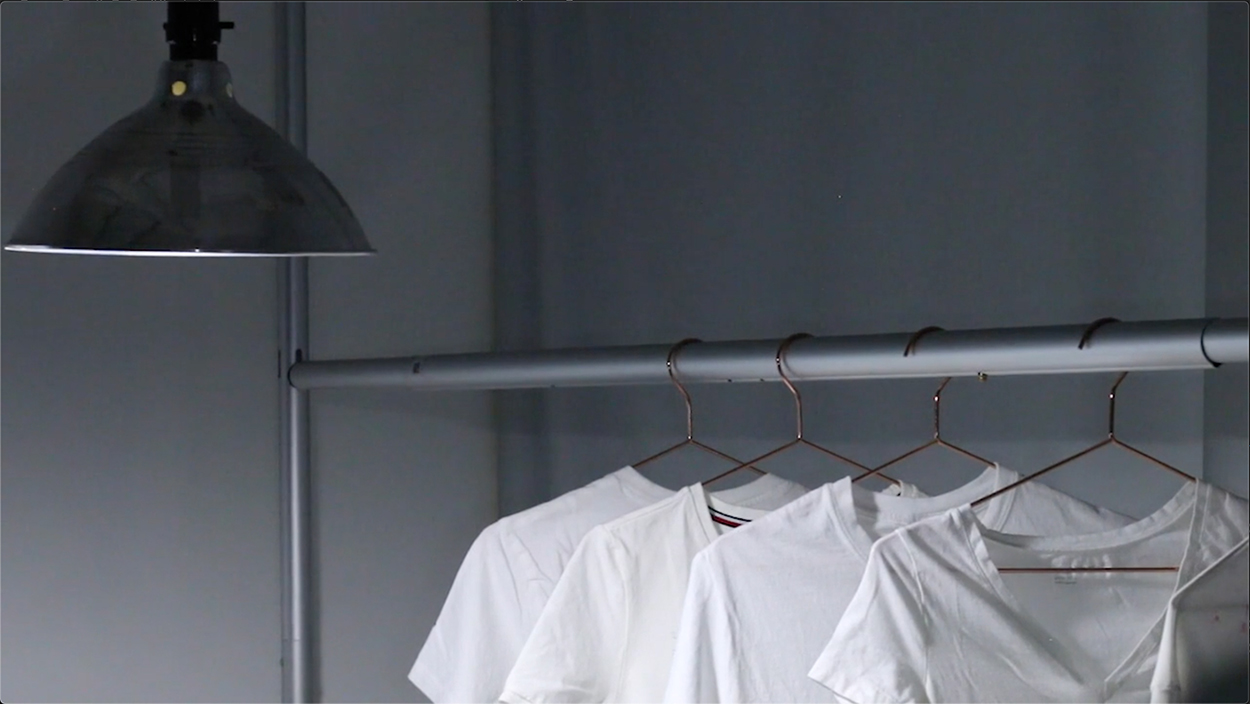
이는 국가, 노동, 자본, 문화 예술간의 관계와 흐름을 단편적인 모방하며 진행된다. 궁극적으론, 판매의 형식으로 미국에서 진행되는 1차 전시와 1차를 바탕으로 한 영상을 이용해 다채널 실시간 비디오 설치로 재구성되는 2차 전시로 나뉜다. 1차 작업에서는 5개 이주노동자의 기사 발췌 글을, 한글 서예로 기록하여, 50개의 중고 티셔츠에 인쇄한다. 이는 판매와 소비라는 형태로 시카고 미국에서 전시되며, ‘소비자’라는관객을 초대한다. (이때 판매의 수익 80%는 이주노동자와 이주여성을 지원하는 단체에 돌아가지만 이에 대한 설명은 미국의 소비자/관객에게 적극적으로 홍보하지 않는다) 1차 프로젝트 진행과 동시, 가판대에 놓인 옷 꾸러미와 소비자의 손길은 실시간 영상이 촬영되어 한국에 전송된다. 이 영상은 한국에서 2차 작업인 미디어 설치작업의 형태로 진행될 예정이다.

한글을 읽을 수 없는 ‘외국인’보다, 우리는 셔츠의 글이 가지고 있는 뜻을 이해하고 문제에 공감한다고 말 할 수 있을까? 한글을 읽을 수 있는 ‘우리’의 집단은 한국 땅에서 일어나는 이 이야기를 다르게 소비 할 수 있을까? 예술, 티셔츠, 기부, 착취가 공존하는 사물이 판매될때, 구매자의 소비는 무엇을 향하고 위한 것일까? 난 이 프로젝트를 통해 화자와 청자, 생산자와 소비자, 외국인과 내국인, 피해자와 가해자의 관계가 명확하지 않은 관계를 좁혀가며 ‘나’라는 존재가 어떤 가치와 사회에 의존하고 있으며 그 의미란 무엇인가, 그리고 복잡하게 얽혀있는 사회 속 ‘나’라는 사람이 어떻게 연결되어있는지 묻고 싶다.
A Night Visible to the Naked Eye is concerned with the exploitation of migrant workers under the neoliberal economy. The form of the project mimics entangled relationships among nations, labor, capital, and arts, demonstrating how this global economy interconnects one another. It is presented simultaneously in two locations, CAC (Chicago, 2022) Buddy (Chicago, 2024), an art store, and Roud Gallery (Seoul, 2022) Apexart (New York City, 2024), an art gallery, connected through live videos broadcasting from each exhibiting location. Part 1 is the print t-shirt sale, where overhead cameras capture shoppers’ hands searching for clothing at the store. These print t-shirts, mainly made in “under-developing” or “developing” countries, contain 5 excerpts of articles about the exploitations of migrant workers in South Korea written in Korean calligraphy; Part 2 is a multi-channel video installation of migrant farm workers’ working hands, juxtaposed with live and pre-recorded videos of shoppers/audience’s hands at an art gallery.
This project intentionally presents others’ tragedies and oriental elements as sellable items in the form of art, and the shoppers/audience’s interactions are surveilled by the people in the other location. Circumstantially, I give the audience passive roles as bystanders for the Korean-reading audience and consumers for the non-Korean reading audience.
2022/2024
Site-specific, participatory project held at two different locations linked via live video feeds. Location 1: Second-hand T-shirts manufactured in Vietnam, Cambodia, Bangladesh, Indonesia, and other countries; five Korean-language article excerpts on migrant-worker exploitation printed on the shirts; three live-feed cameras capturing on the t-shirt display table. Location 2: Multiple video footage of the hands of five migrant farm workers; live and recorded video of shoppers’ hands searching through T-shirts at the first site.
Live feed on 01/07/2022-01/31/2022 between Chicago and Seoul
Live feed on 22/03/2024 – 18/05/2024 between Chicago and New York City
Dimensions variable
Seoul installation photo and video by Hyunju Kim
Chicago installation photo and video by Juneer Kibria and Nayeon Yang
The project website is no longer available. https://avisiblenight.com
This program is
partially supported by a grant from the Illinois Arts Council Agency.